Mysterium Magnum – Origins of Metallurgy in Central Europe
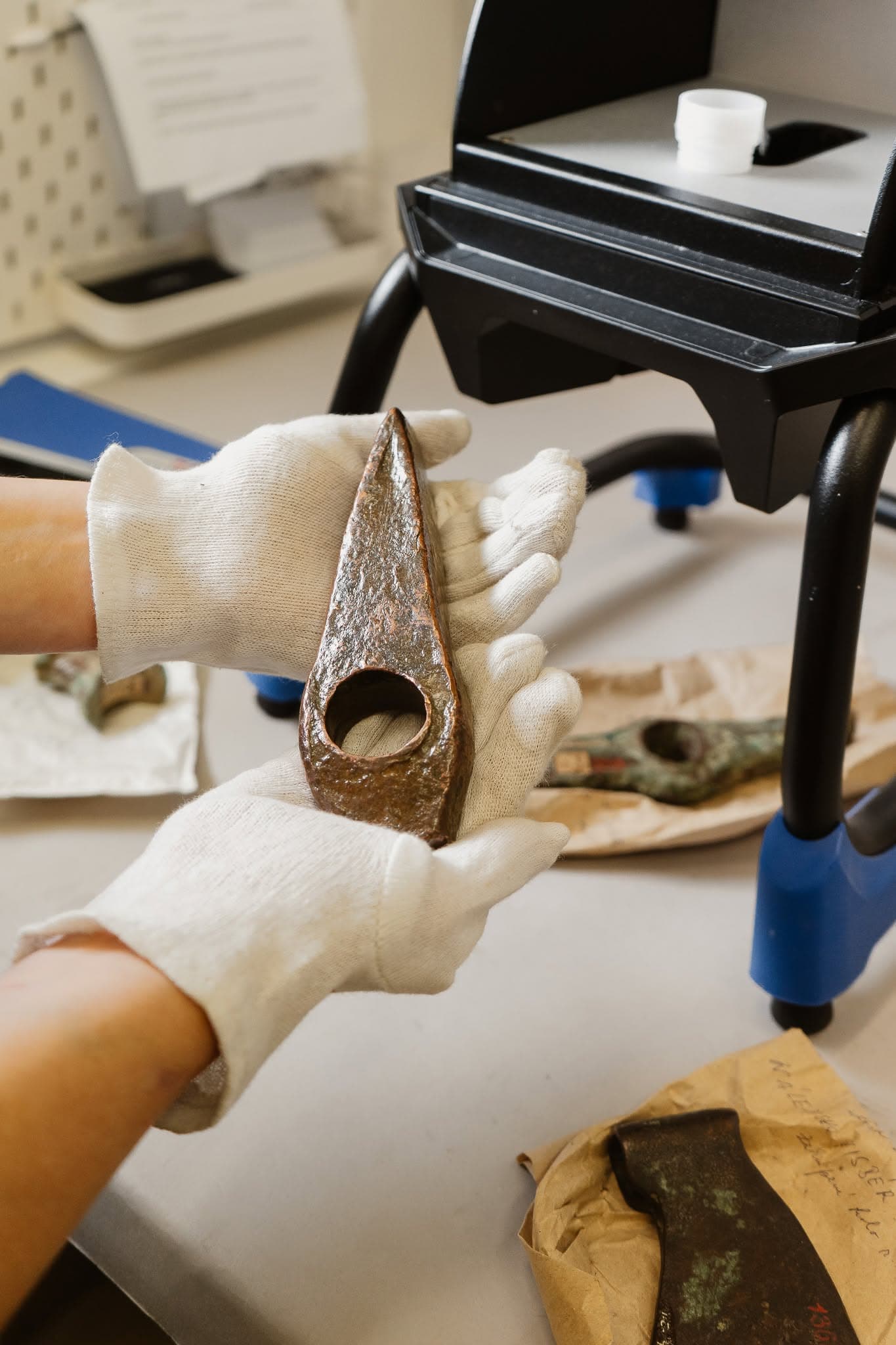
Researchers from the four Visegrád Group (V4) countries are investigating the origins of non-ferrous metallurgy in Central Europe, dating back to the 5th millennium BCE. Using a range of scientific methods, they are examining the provenance of copper artefacts discovered at archaeological sites to determine whether they were made from local Carpathian copper or copper originating as far away as southeastern Europe or the Alps.
This remains one of the key unresolved questions in modern archaeological research. The core project team consists of archaeologists from four research institutions in the Czech Republic, Slovakia, Hungary and Poland. Archaeologists from the Bratislava City Museum collect and coordinate data collection in Slovakia, including samples of raw materials and archaeological finds, and contribute to the analysis, presentation and publication of the research findings.
Project details
As part of the project, we are investigating the provenance of copper ore, copper semi-finished products and artefacts in Central Europe dating to the 5th millennium BCE, when non-ferrous metallurgy began to develop on both sides of the Western Carpathians. Our research focuses on western Slovakia, northern Hungary, Moravia and Silesia.
Our aim is to develop and publish a unified database of archaeological finds and their characteristics from all these regions, collect samples of copper ores from potential primary sources (e.g. the Little Carpathians), and gather samples of archaeological copper from excavation sites. These samples will be examined using modern analytical methods, including energy-dispersive X-ray fluorescence spectroscopy (ED-XRF), neutron activation analysis (NAA) and lead isotope analysis, in cooperation with laboratories in Prague (Nuclear Physics Institute of the Czech Academy of Sciences, CZ) and Mannheim (Curt-Engelhorn Centre for Archaeometry, DE).
We will compare the chemical composition of ores from primary sources with that of artefacts dating to the period under investigation, as well as with existing data from Europe and the Balkans.
In western Slovakia, we are collecting samples of copper minerals (chalcopyrite, tetrahedrite and malachite), primarily through surface surveys of accessible sites in the Little Carpathians. Our research hypothesis is that copper deposits in the Little Carpathians were known, mined and processed during the 5th–4th millennia cal BC. However, current archaeological evidence does not yet confirm this hypothesis, particularly due to the absence of dated surface mines and mining pits in the Little Carpathians region.